



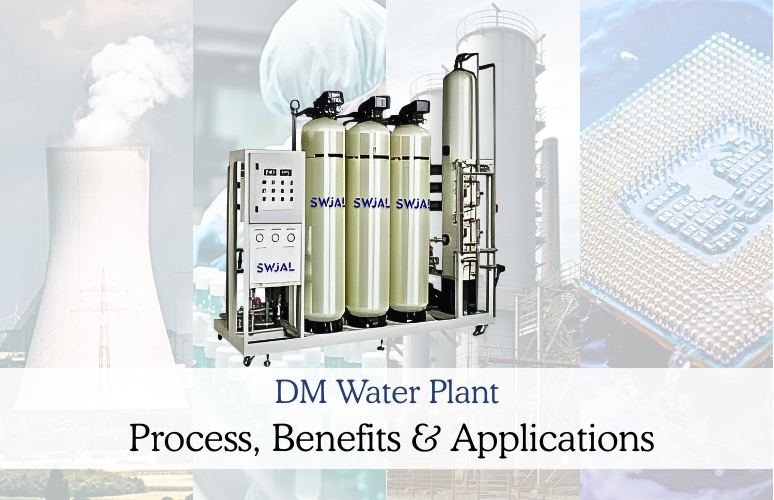
Introduction
A DM (Demineralization) Water Plant is a water treatment system designed to remove dissolved minerals and salts from raw water, producing ultra-pure demineralized water. Industries such as pharmaceuticals, power plants, chemical processing, electronics, and laboratories rely on DM water to prevent scaling, corrosion, and contamination. Understanding the DM water plant process is essential for industries seeking efficient operations, consistent water quality, and long-lasting equipment protection.
What is Demineralized (DM) Water?
Demineralized water, also known as deionized water, is water free from dissolved salts, minerals, and ions like calcium, magnesium, sodium, chloride, and sulfate.
Benefits of DM Water
- Protects boilers and pipelines from scaling
- Ensures consistent water quality
- Essential for sensitive industrial processes
DM Water Plant Process Steps
1. Raw Water Intake and Pretreatment
Before demineralization, water undergoes pretreatment to remove impurities:
- Sedimentation – Removes large solids
- Filtration – Removes suspended particles
- Activated Carbon Filtration – Reduces odor, color, and organic matter
Proper pretreatment ensures longer resin life and smooth plant operation.
2. Ion Exchange Process
The ion exchange system is the core of a DM water plant. It removes dissolved ions from water using specialized resins.
- Cation Exchange: Removes positive ions like calcium (Ca²⁺), magnesium (Mg²⁺), and sodium (Na⁺), replacing them with hydrogen ions (H⁺).
- Anion Exchange: Removes negative ions such as chloride (Cl⁻), sulfate (SO₄²⁻), and bicarbonate (HCO₃⁻), replacing them with hydroxide ions (OH⁻).
The H⁺ and OH⁻ ions combine to form pure water (H₂O), effectively removing nearly all dissolved minerals.
3. Mixed Bed Polisher (Optional)
For ultra-pure water, a mixed bed unit combines cation and anion resins in a single vessel. This ensures maximum purity, which is critical for pharmaceuticals, electronics, and laboratory applications.
4. Resin Regeneration
Ion exchange resins become saturated over time and require regeneration:
- Cation Resins – Regenerated with acids
- Anion Resins – Regenerated with alkalis
Regeneration restores resin efficiency, allowing continuous production of high-quality water.
Applications of DM Water
De-mineralized (DM) water is widely used in industries where high-purity water is essential for maintaining product quality, extending equipment life, and improving process efficiency.
- Power Plants – Used as boiler feed water and for steam generation, preventing scaling and corrosion.
- Pharmaceutical Industry – Used in drug manufacturing, equipment cleaning, and laboratory testing, where water purity is critical for safety and compliance.
- Electronics Industry – Used in PCB cleaning and semiconductor manufacturing, ensuring contamination-free production.
- Chemical Industry – Used for chemical mixing, dilution, and other process applications, maintaining reaction accuracy and consistency.
- Laboratories – Used for experiments, testing, and reagent preparation, ensuring reliable and accurate results.
Benefits of a DM Water Plant
- Delivers High-Purity Water
Produces water free from dissolved salts and minerals, ensuring reliable purity for sensitive applications. - Prevents Scaling and Corrosion
Protects boilers, pipelines, and machinery from scale formation and corrosion, improving operational efficiency. - Maintains Consistent Water Quality
Ensures uniform, high-quality water essential for uninterrupted industrial processes. - Lowers Maintenance & Operating Costs
Reduces frequent repairs and downtime while extending the overall life of equipment. - Essential for Critical Industries
Supports industries such as pharmaceuticals, power plants, electronics, and chemicals where pure water is mandatory.
Conclusion
The DM water plant process is vital for producing high-purity water in industrial and laboratory settings. By removing dissolved minerals and salts, DM plants protect equipment, reduce maintenance costs, and ensure consistent product quality. Investing in a DM water plant provides reliable, efficient, and safe water treatment, making it indispensable for modern industries.


Comments are closed